
Is Your Lawn Mower Rightsized?
Don’t let grass cutting eat up your budget.
Reviewed: November 9, 2025
You’ve decided you need a lawn mower, because you have a lawn and not keeping it trim would draw the ire of your neighbors.
Fair enough. But nowadays you have so many choices, from the old-fashioned reel mower to the modern zero-turn behemoth. Plenty of articles go into the nuances of each choice, but what I want to do is zoom out and question the conventional wisdom that leads to some people buying “too much mower” for their needs, harming both their wallet and the earth.
To be clear, this is not to dissuade anyone from buying what fits their personal situation, but it may get someone who is on the fence to gravitate toward the more efficient options. So, let’s dig in.
Joyriding in the yard
Let’s look at a use case involving these parameters:
- 1/4 acre lawn
- Able-bodied homeowner
- Lawn tractor vs. push mower
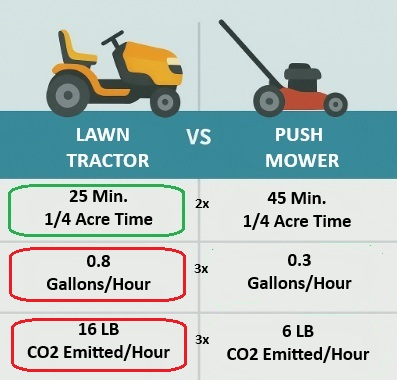
Assuming you are able, i.e., don’t have a disability or other physical limitation, selecting the right type of mower primarily comes down to lawn size. Estimates of the average U.S. residential lawn size vary greatly, especially by region, but consensus puts it at around 11,000 square feet, or 1/4 of an acre. This might take around 45 minutes to mow with a push mower and 25 minutes with a lawn tractor.
If you only consider this one factor, the lawn tractor wins out since you save 20 minutes. But as we’ll see, there are hidden costs that work against the lawn tractor when trying to justify it for our average lawn.
Consider that you are paying for a machine to transport you across every inch of your lawn. This requires extra fuel and horsepower but itself contributes nothing to the end goal of having a nice, trim lawn. In fact, it does the opposite, since driving what is essentially a heavy four-wheeler across your lawn will compress the soil, which can harm the grass over time.
Let’s break that down using rough numbers for simplicity. The push mower takes about 2 times as long to cut the grass over the lawn tractor. However, the average lawn tractor tends to be closer to 3 times as inefficient as the push mower during use, not 2 as you might expect. That 1 extra part inefficiency is a consequence of the machine having to be strong enough to carry your body, as mentioned. This tradeoff translates to a disproportionate fuel use and carbon footprint.
For the average homeowner with a 1/4 acre lawn, a riding mower would be overkill if we’re being logical.
This is illustrated in the chart below. In summary, you can see that the operating cost is almost 3 times higher on the lawn tractor, but you’re only getting about 2 times the operational benefit over the push mower. And that’s before considering the added costs related to the purchase, maintenance, and storage of the lawn tractor. Nor does it consider the added emissions produced during manufacturing, transport, and eventual disposal.
In most cases, these extra costs can logically only be justified when the time difference of mowing with the push mower vs. the lawn tractor exceeds a threshold. In other words, as the lawn size increases, so does the value proposition of having a lawn tractor. For a 1/4 acre lawn, the difference in mowing time is only 20 minutes, but at 1 acre the push mower adds 80 minutes, and most people simply don’t have that kind of time or energy to devote to cutting grass.
Now, you might object and say that saving time is not the only benefit of the lawn tractor, that less exertion and therefore comfort is the other major benefit. And you’d be right, in a sense. However, it’s also true that an overdependence on comfort for its own sake has made society unhealthier.
That is to say, if you are an able-bodied individual using a lawn tractor and not getting enough regular exercise elsewhere, this habit could be exacting a physical and mental health toll over time that dwarfs the already higher cost of the machine itself.
The U.S. Centers for Disease Control and Prevention (CDC) touts the benefits of walking 8,000 steps a day, or about 4 miles. Given that it takes most people 15-20 minutes to walk a mile, traversing the average lawn behind a mower should give you roughly 1 mile of walking. That’s only 25% of your recommended daily step goal, so it really hammers home the idea that we should be going out of our way to use our own bodies more rather than over-relying on outsourced machine labor.
Mowing a 1/4 acre lawn on foot gives you about 25% of your recommended daily step goal.
Health experts are always reminding us to park farther away or take the stairs instead of the elevator; now we can add “use a push mower” to that sagely advice, at least for those of us with average-sized lawns who could stand to walk more.
Not just about exercise
If the mower is gas powered, there are additional health considerations. Gas lawn mowers are notoriously polluting (much more so than cars due to less stringent standards), and riding mowers lead the pack. Relying on them increases the risk of various cancers and respiratory ailments to you, your family, and everyone in your community.
Granted, the risk from a solitary mower is negligible, but it tends to compound when you think of all the other people around you with huge lawns or whose mowing preferences may be less than optimal.
Compared to push mowers, riding mowers also amplify inherent safety issues. Many of us have heard the horror stories of unwitting riders backing into children they couldn’t see. Yet that’s hardly the only issue at play.
How many of us have stopped to consider the noise impact? While zero-turn mowers tend to be the loudest, even lawn tractors are much louder than push mowers, producing a 90-95 decibel sound that can damage your hearing after one use. It can also wake your household or the neighbors if, like me, you prefer to do your mowing bright and early to avoid the midday heat. If you do use a gas mower, and especially if it’s a riding mower, be sure to wear hearing protection.
It takes just 1 hour of a 94-decibel sound to suffer permanent hearing loss.
Given the extra maintenance required on what is a more complex machine, it’s questionable for smaller lawns that a riding mower is even saving you much time in the end, negating a major reason for getting one in the first place.
None of this is to say that riding mowers are inherently bad. Remember, we are talking about averages here, and our case study involves a 1/4 acre lawn and an able homeowner. Someone with a larger lawn or who has mobility issues would be well-justified in buying a more capable machine based on their needs.
In our average case, however, some variation of a walk-behind mower is likely to be the best bet overall. This could be a standard push mower, or a self-propelled version that offers an assist at the cost of slightly reduced efficiency. In fact, self-propelled mowers can be a great compromise for those on the fence between a standard push mower and a riding mower.
At what point does the riding mower become cost effective? When you are either wasting too much time mowing or are overexerting yourself. Experts generally suggest half an acre as a reasonable threshold, assuming you are physically able.
A no motor mower. For reel?
Let’s look at another use case, this time on the other end of the size spectrum. Let’s say you have a townhouse or other typically smaller property, with a lawn that is much smaller than our 1/4 acre average. In this case, you may not need a traditional lawn mower at all.
After all, such mowers are inherently inefficient, requiring an external power source in the form of electricity or gas. They do the job, but is there a better way, one that will leave you with more disposable income and a healthier self when mowing season is over?
Well, you might be familiar with the manual reel mowers that have made a comeback. With these, there is no engine or fuel to worry about. Pushing the mower across the lawn turns the wheels, which link to a gear system that turns the blades. It’s human-powered, like a bicycle, so it’s also good exercise despite the machine being lightweight. Battery electric reel mowers are available as well for those who need the assist.

A primary advantage of reel mowers, in addition to being almost silent, is that they are cheap and easy to maintain.
Note that this type of mower is best suited to flat lawns that are mostly grass. It won’t do well with weeds or hard objects like sticks and pinecones. Although the machines themselves are low maintenance, it takes slightly longer to do the job, mainly because the cutting widths tend to be comparatively less than those of the powered alternatives.
But if you have a small, level plot, few trees or weeds, and are able-bodied, then the small time disadvantage becomes insignificant and you may consider yourself the poster child for reel mowers. Low cost, almost zero noise/pollution/upkeep, and a free workout opening up the possibility of canceling that wallet-draining gym membership. What’s not to love?
Advanced technology is not always for the best; sometimes you have to take a step back in order to go forward.
Size matters with electric too
So far, we’ve only discussed mower size. We reviewed a case where push mowers win out over riding mowers, and one where reel mowers win out over push mowers.
We also touched on the drawbacks of gas mowers, which are noisy and emit more pollution than a car, among other problems.
Electric lawn mowers mitigate most of these problems, but they too need to be rightsized. Looking at cordless models in particular, make sure the published battery range aligns with your lawn size. Too small of a battery and you’ll be left with a dead mower and a half-cut lawn. Too large and you’ll overpay in battery price and weight.
Weight matters because a heavier battery not only requires more resources to manufacture but also more energy to move it across the lawn. That motive energy has to come from food if you’re pushing the mower, or from electricity if the mower is pushing itself. Either way, it translates to less money in your wallet for no real benefit if you’re never going to discharge the battery beyond a certain percentage.
Since batteries degrade over time, buy one with a somewhat larger capacity than needed, but not overly so.
Pro tip: You can get away with a much smaller battery by dividing and conquering the lawn, e.g., mowing half one day, half another day, and charging in between. If you mow often, which is recommended anyway for lawn health, the difference in grass height between the two lawn areas shouldn’t be noticeable, especially if there is a fence, driveway, or other structure separating them. This will also spread out your work and help prevent overexertion if you have a bigger lawn.
Electric for the win
Speaking of electric mowers, allow me to plug them here (haha) in case you’re not sold on them yet. These mowers are as popular as ever, but it has taken us a while to get here. I’ve been using them for decades with great success, so I’ve never understood the slow adoption rate.
The standard argument is they are more expensive, but Consumer Reports has found that your average electric mower is actually cheaper in the long run when you factor in gas prices along with annual maintenance. The other argument is they are underpowered, but the truth is the best models meet or exceed the power of gas, and they can be had in both corded and cordless varieties, manual and self-propelled.
If you’ve never experienced the almost meditative bliss of a mower that doesn’t require you to wear noise-canceling headphones, doesn’t reek of unburned gas, and just works every time you start it, you’re missing out.
If the mower is cordless and there’s a battery involved, charging it usually works like your cell phone–just plug it in and forget about it until the next use. With some models, the mower itself needs to be stored near a power outlet for charging. With others, the battery is easily detached so it can be charged separately, which is helpful if you don’t have a power outlet in the shed or wherever the mower will be stored.
Yes, you will need to replace the battery every few years (4-5 in my experience). Then again, there are no expenses related to fuel, oil, filters, or spark plugs, things that can add up and become a routine hassle. Then there are those annoying last-minute runs to the gas station with a canister to fill up, something you’ll never have to do again if you go electric.
What about the robots?
A subtype of electric mower that we haven’t discussed is the robotic automated mower. Think robot vacuum cleaner, but for lawns. This type of mower shows long-term promise but still remains a niche item primarily due to its high cost and setup hassle. This will change over time as the tech improves and adoption follows.
Conclusion
If you are in the market for a lawn mower, you have more choices than ever. Whatever you go with, make sure it’s rightsized for the lawn you are mowing. The average lawn doesn’t require a riding mower in most cases, and a small lawn may not require a powered mower at all.
The venerable gasoline mower has served us well for a long time, but its modern electric brethren have been stealing market share since around the turn of the century, and for good reason. Just remember that they too need to be rightsized–for cordless mowers in particular, you may be able to get away with a much smaller battery by tweaking your mowing habits.
In this age of heightened eco-consciousness and belt tightening, it pays to rethink our default preference for buying the biggest, most powerful tools we can afford. There are often smarter choices out there for those who are not tied to norms based on tradition.