
Exercise Smarter, Not Longer
The most efficient workouts don’t require you to spend hours at the gym.
Reviewed: August 30, 2026
Exercise is key to strengthening the heart, managing weight, and improving overall physical and mental health. It ranks up there with healthy eating as one of the top ways to improve our daily functioning. Indeed, the two go hand-in-hand as eating the right nutrients is essential for maximizing body performance, recovery, and energy levels. But even some of us who eat well lack the time or motivation to make exercise a meaningful part of our daily routine.
When you hear the word “exercise”, you probably picture a chiseled gym rat pumping iron or a lean long-distance runner running a marathon. But those are just activities that take exercise to its logical extreme. There’s no reason to be disheartened that you’re not that person. In fact, it may be a plus as such roles typically require a large time commitment while also increasing the risk of injury, particularly with age.
At its core, exercise is just structured physical activity. The nice thing about physical activity is that everyday movement counts. Whether it’s mowing your lawn, washing dishes, or even just fidgeting in place, anything that works your muscles and joints is going to bring health benefits, even if they don’t count as exercise in the usual sense.
In fact, movement is so fundamental to a life well-lived that just the simple, regular variety can bring meaningful health benefits on its own outside of dedicated exercise.
Movement via the mundane
Okinawa, Japan, is one of the famed “blue zones” of the world, where people live seemingly forever and have exceptionally low rates of chronic disease. This is particularly true of the older generation, owing to their traditional diets and habits. Along with eating well and having strong social connections and a relaxed mindset, the elderly of Okinawa have an active lifestyle.
A key to their longevity isn’t intensity, but regularity woven into their daily routines. Rather than going to the gym, they take neighborhood strolls, do gardening, and sing at karaoke bars. They sit and even sleep on the floor and get up dozens of times a day, naturally strengthening their legs, back, and core muscles.

In the modern world, many of us tend to just sit…and sit…and sit. After just 30 minutes of sitting, your metabolism slows down. After 2 hours, your good cholesterol levels drop. Fortunately, taking a 5-minute break every 30 minutes can improve some of these measures. You can help encourage that by using a break reminder app, or by drinking more water, which will cause you to get up more to use the toilet. A lot of us could use more water anyway.
Apart from that, enhancing everyday routines is a perfect way to incorporate more movement into your day since they’re already frequent and automatic. As the water runs over you in the shower, scrub more quickly than usual and get your heart beating a little faster. It’s not only healthier but will also get you out quicker, saving you time, and saving you money since you’re using less water.
You can apply this same mindset to almost everything you do. Park your car in the first spot you see, even if it’s not the closest. Use a manual toothbrush rather than electric. Buy the smallest lawn mower that still does the job. Doing the slightly harder thing can improve your health while giving you back money in the process. As a bonus, all these things happen to be better for the environment too.
Want better health? Do your chores with gusto! You have to do them anyway.
Individually, none of these steps will make much of a difference. But they certainly add up over a longer time period. Especially when they start to become habits that you don’t even have to think about.
But while every bit of physical activity helps, light movement is not enough to truly maximize your health. From a bodily maintenance standpoint, the two major reasons to do actual exercise–as in higher-intensity movement–are to maintain muscle (through strength training), and to keep the heart and lungs functioning optimally (through cardio training).
Make it a game, make it your job
The problem with exercise today, though, is that it tends to be all work and no fun. Few people enjoy getting on a machine to run endlessly in place. Or lifting a set of weights the same way repeatedly only to do it again in the next day or two–and unless you’re trying to look like a bodybuilder, it isn’t really necessary either. The bottom line is that finding the motivation to be consistent can be a real issue.
A solution, then, is to make it enjoyable. If you hate going to the gym, find a team sport that you like. Roughhouse with the kids. Play one of those dance video games. Ride your bike in nature or take a brisk walk. Whatever it is, find a friend to do it with so that it seems like even less work.
The other tactic is to make it unavoidable. One way is finding a day a job that requires movement. Unfortunately, many of us are chained to our desks during the day. So how about finding a physically demanding second job or activity that you can do nights or weekends? Can you referee a peewee sports league? Work as a courier, delivering packages by bicycle? Do landscaping? Serve at a busy restaurant? Walk dogs?
Or how about a volunteer position that also makes you feel like you’re doing something positive for the community? Can you help build houses for the needy? Do disaster relief? Hike through and maintain park trails? Coach a sport? Work at a community garden, weeding and carrying mulch? Anything that challenges your body and gets your heart rate up for several minutes at a time counts as exercise.
That last point is important because some activities that might seem demanding on paper don’t guarantee you’ll meet your cardio and strength training needs by doing them. For example, even some sports just don’t get you moving enough or in the right ways. There are the obvious ones like golf and bowling, but also some team sports like baseball where you spend much of your time standing around waiting for something to happen.
While these “lite” sports are great ways to incorporate movement into your day, they don’t count as exercise in the way that our functional health demands, so just keep that in mind.
So what’s wrong with the gym, Jim?
The gym is synonymous with exercise. It’s often the first thing that comes to mind when you hear the word. But is it the best solution? Well, like anything else, it has its pros and cons.
People choose the gym for various reasons that have to do mostly with psychology. At home, there’s no accountability. No one cares if you’re not working out, and you’re surrounded by distractions. With the gym, you are there for one reason: You have paid good money to occupy a building full of workout gear where everyone around you is working out, distinctly motivating you to do the same.
Having access to various types of equipment is another plus for some people. If your goal is to bulk up, for example, you might go from one set of weights to a heavier set after a few weeks. It doesn’t make sense to fill up a room in your house with thousands of dollars’ worth of equipment that you will only use for a short while.
And then there’s the social aspect. Maybe you have a workout buddy or trainer who assists you or keeps you motivated. Or maybe you go to meet new people and chit chat. Some people enjoy seeing familiar faces every day and sharing a sense of community.
Taking it a step further, we all have goals, but for some the gym is the goal. There is a sense of accomplishment from seeing yourself get stronger every day, meeting the metrics you have set for yourself, and doing it all in the company of others and sharing your results.
That is all well, but for some of us the gym is just a means to an end. If your primary reason to work out is maintaining a baseline fitness level in the most efficient way possible, then home workouts are a superior alternative.
Working out at home is free, there’s no commute, no risk of catching the disease of the day, and you can stay in your pjs if you want. It’s measurably faster, cheaper, and greener. And your clean, unshared shower is right there when you’re done working out.
Speaking of efficiency, this leads us to a specific type of workout that can quickly and easily be done from home.
HIIT me with your best shot
How are we supposed to get our cardio and strength training in if we don’t have the time, money, or inclination to go the gym or join a sports team?
A great solution is HIIT–high-intensity interval training. This type of exercise involves short bursts of intense movement. It is one of the most time-efficient way to burn calories, increase cardiovascular fitness, and boost metabolism. Practical benefits include:
- Provides a free, fully customizable, full-body workout.
- Requires very little time commitment (a few minutes per week provides measurable benefits).
- Can be done at home or anywhere, with no special equipment required.
Much of HIIT can be tailored to your ability and preferences, but the basic pattern is to do several seconds of a chosen exercise at high intensity, followed by several seconds of rest. Repeat this for a total of 5 minutes and you’re done!
That’s not to say it’s easy. A fundamental rule of HIIT is to push yourself to near-maximum effort during the exercise phases (called sprints), and to be relatively still during the rest phases. This contrast of taxing your heart and then allowing it to recover is what confers the cardio benefits of HIIT in less time than a traditional workout. After completing a HIIT session, you should be breathing too hard to speak a full sentence.
It’s no surprise that the intensity and stress of HIIT may make it inappropriate for those who are not already in decent shape. The good news is that you can get a roughly equivalent workout by lowering the intensity while increasing the total workout time. After all, HIIT is just normal exercise that has been time-crunched.
The trick, then, is to determine how much intensity you can tolerate versus how much time you want to spend on your workouts.
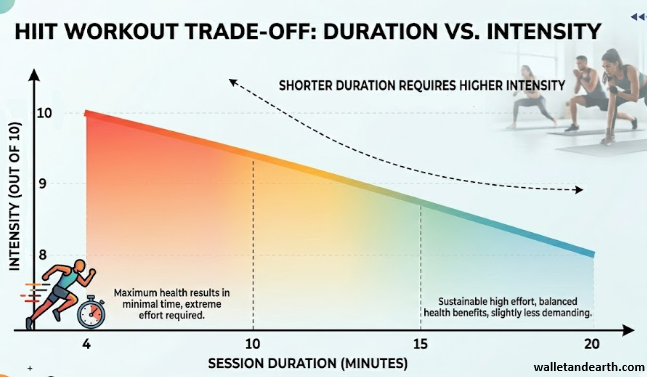
The strength training aspect of HIIT comes from the specific exercises you choose to do. For example, you could do push-ups if you want to strengthen your arms, or squats if you’re targeting your legs. You can (and should) mix and match various exercises in a single HIIT session so as not to overwork one set of muscles. You can also customize the timing of each interval.
Note that HIIT is not a full replacement for traditional cardio or strength training. But it gets you most of the way there at a fraction of the time. It won’t maximize calorie burn or make you into a bodybuilder. But it will keep you fit at a cost of just a few minutes a day and minimal fuss.
Here’s my personal HIIT routine, just as an example. I do 2 rounds of 4 exercises each. I use a mobile app called Interval Timer to guide me through the exercises.
- Warm up through light stretches and movements (1 minute).
- Jumping jacks (25 seconds).
- Rest (15 seconds).
- Pushups (25 seconds).
- Rest (15 seconds).
- Air squats (25 seconds).
- Rest (15 seconds).
- Army crawl (25 seconds).
- Rest (15 seconds).
- Jumping jacks (25 seconds).
- Rest (15 seconds).
- Burpees (25 seconds).
- Rest (15 seconds).
- Lunges (25 seconds).
- Rest (15 seconds).
- Army crawl (25 seconds).
- Cool down by doing a quick chore or walking around for a few minutes.
So total session time for me is about 5 minutes. If you’re just starting out, you’ll want to opt for longer rest periods, say, a full minute, so that your body can recover between sprints. You could then gradually move to shorter rest periods as you feel your body adapting. Age is another factor–the increasingly longer recovery times may call for longer rest periods. Age also calls for lower impact exercises, as do obesity and other medical conditions.
As mentioned above, you can tailor the intervals and number of rounds to your body, but 5 minutes of HIIT training per session is enough to confer major benefits to the various body systems.
As exercise, HIIT can work nearly as well as longer, more elaborate workouts, but with far less friction and time needed.
It may be tempting to skip the initial warmup and jump straight into the exercises, but don’t do this as you may risk injury. The warm-up is the transition between complete rest and full-on movement. It preps your body and allows you to push harder through the workout.
The cooldown at the end is also a good idea, lowering bodily stress after a hard workout and providing a gradual transition back to rest.
As far as frequency, you don’t want to do HIIT every day as your body needs roughly 48 hours of recovery time between sessions. But you don’t want to wait too long either–doing HIIT only once a week is not really enough for fitness and also increases the risk of injury as your muscles and joints weaken from disuse.
Morning or afternoon work best, as working out after dinner can interfere with sleep in some people. In fact, try to avoid any real exercise right after eating (gentle walking is fine). Giving your body a couple hours to digest any heavy meal eaten avoids triggering an upset stomach or making you tired.
Notice my exercises are all calisthenics, meaning I do not use any exercise equipment, just my own bodyweight. I’ve designed my routine to strengthen different areas of the body while not overworking any one area.
If you prefer to use exercise equipment, such as a stationary bike, elliptical, or weights, you can still go that route with HIIT. That might even be the best choice in some cases–if you’re overweight, for example, some machines can be easier on the joints than typical bodyweight exercises. But as I personally prefer the minimalistic approach, the only piece of “equipment” I use personally is a foam mat under my body for cushioning.
You don’t have to buy a mat if you already have a decent one in front of your kitchen sink or stove that you can temporarily borrow. Regardless of where it comes from, I strongly recommend using a mat for bodyweight training (HIIT or not), for several reasons:
- It enables a far more comfortable experience over a hard floor or even carpeting.
- It’s easier on the joints and reduces the risk of injury.
- It protects your flooring, especially if you always exercise in the same spot.
- Compared to a carpeted floor, less dust tends to get kicked up that you then breathe.
- You get a quieter workout, especially important if you have neighbors below you, or others nearby who could be disturbed.
If you don’t have a mat lying around, buy one! They’re not expensive and, even if you give up on HIIT in the end, it’s a small comfort having a mat under your feet when cooking, doing dishes, or anything else that has you standing shoeless in one place.
Again, before starting an exercise regimen as aggressive as HIIT, make sure you are getting adequate nutrition so your body can handle it, and consider clearing it with your doctor first. Then start off slowly so your body can adapt over time. The key is to make the reps challenging, but not so much that it makes recovery challenging afterwards.
Above all, listen to your body and don’t overexert yourself. Lower the intensity or stop completely if you develop strange symptoms or don’t seem to be recovering from a workout. HIIT puts a lot of strain on the body and hurting it would be counterproductive.
If you find your HIIT routine to be overly taxing, take it a notch down, i.e., lessen the intensity or lengthen the time period. If it’s still too much, consider traditional exercise or other movement. That could mean a short walk or run, or even just light activities around the house or garden. Any action is better than none, and you can gradually work your way up to more intense activities if your body permits it.
Conclusion
You don’t need a gym membership, expensive equipment, or hours of free time to make exercise part of your life. Regular movement throughout the day is valuable and can be woven into everyday life to help you become more active.
For those who struggle to find the time or motivation for conventional workouts, HIIT can be an efficient option. Short, challenging intervals can improve cardiovascular fitness and build strength at home while also saving you the cost of a gym membership.
But the best exercise is the one that gets done consistently, and taking a less rigid view of the word makes that more likely to happen. That could mean doing more chores yourself, picking up a recreational sport or other physical activity that you enjoy, dancing, or volunteering on the weekends. Start where you are and make movement an increasing part of your routine.